


How renewable energy teams reduce billing errors with automated market price data
Renewable energy billing can be risky and time-consuming. Learn how finance and commercial teams are using automated market price integration to reduce errors and speed up invoicing.

No matter where an asset operates, renewable energy billing is rarely straightforward. Each month, finance and commercial teams need to pull the right market price, apply the right contract formula, and make sure the invoice aligns with the latest regulatory rules before it goes out the door.
In North America, that means retrieving nodal or hub-level prices from Independent System Operators (ISOs), such as CAISO, ERCOT, PJM, NYISO, and more.
In Europe, it means using monthly PV and Wind price data published by the Commission de Régulation de l’Énergie (CRE), as well as market-based prices from exchanges like European Power Exchange (EPEX) SPOT.
Because these numbers shift frequently, and PPA terms evolve, the risk of mistakes is always high, and even the smallest errors can lead to disputes, delayed payments, or failed audits.
Why manual market price management leads to billing errors
Most teams know the billing work itself isn’t the real challenge. It’s gathering and aligning the inputs. Market prices live in one system while contract terms live in another, and formula logic is buried in spreadsheets that only one or two people truly understand. And when something changes, like a revised rate or an updated contract clause, everyone has to update their version of the truth.
Take a finance or billing manager responsible for wind and solar assets across California, Texas, and Michigan. Each month, they need to:
-
Pull the latest day-ahead or nodal prices from CAISO, ERCOT, and PJM
-
Apply each PPA’s billing formula accurately
-
Update invoices to reflect any changes in contract terms
-
Verify that every invoice complies with current market and reporting rules
.jpg?width=1200&height=800&name=AdobeStock_558067926%20(1).jpg)
Doing this once is manageable; however, doing it every month across dozens of assets becomes a full-time job — and a source of risk. In markets like ERCOT, where real-time prices can swing dramatically, a wrong price input can skew an invoice by hundreds or even thousands of dollars per megawatt-hour.
And the risk isn’t just financial. All that manual checking, rechecking, and fixing adds hours to every billing cycle. The result is slow turnaround times, hidden errors that cause disputes, knowledge silos in people's heads, and stressful audits that require hours of digging to prove invoices are correct. For clean energy companies trying to scale without adding headcount, it's simply not sustainable.
How automated market price integration streamlines renewable energy invoicing
The Market Price Integration feature within Unity Invoice Management is designed to solve these challenges at their core. Currently available for assets in Europe (CRE and EPEX SPOT) and North America (ISOs), it takes the most labor-intensive parts of billing and automates them, accurately and consistently.
Here’s how it helps:
Automatic market price ingestion
The platform automatically pulls in nodal and hub prices from all major North American ISOs, along with France’s official CRE reference prices and EPEX SPOT market prices for PV and wind. Everything lives in one place and updates monthly, without manual downloads or file-hunting.
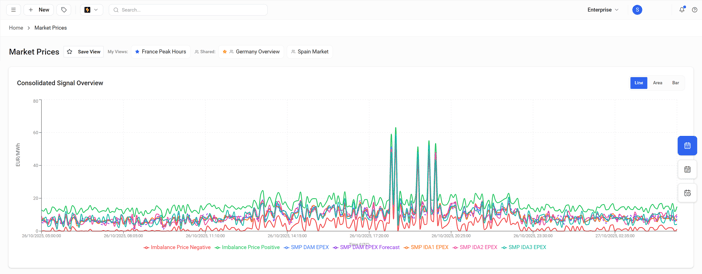
Consolidated Signal Overview showing market prices in a single, updated view
Accurate plant-to-market mapping
Every plant is mapped to the correct market price, from complex nodal locations across North America to country-specific frameworks in Europe, including France's CRE, eliminating guesswork and spreadsheet cross-checks.
Reusable and flexible contract formulas
Complex PPAs can be modeled once and applied everywhere. If a term changes, you update it in one place and the logic updates automatically.
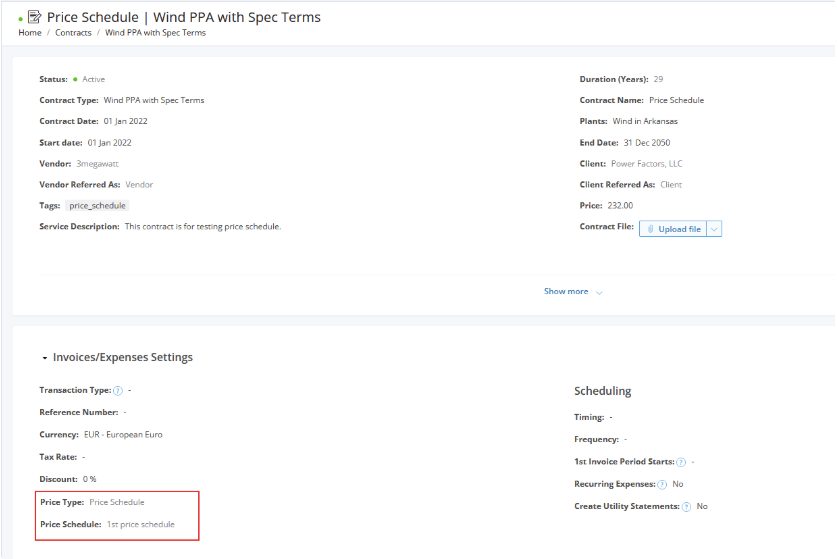
Set up a price schedule once and use it everywhere it applies
Invoices that are audit-ready
Persistent storage, audit logs, and clear user permissions mean questions from customers, auditors, or internal teams can be answered quickly and confidently.
Built-in market insight
Interactive dashboards show how prices move over time, which assets are most sensitive to price changes, and where forecasts may need to be adjusted, helping teams negotiate stronger contracts and catch issues early.
Benefits of renewable energy billing automation
When market prices flow in automatically, billing stops feeling like a monthly chore and becomes a process you can trust. Instead of chasing market pricing data each month, teams can focus on reviewing results and understanding what the numbers actually mean.
The result is far less manual work, fewer disputes and delays, a clean audit trail every month, and clearer visibility into how market swings affect revenue.
For current Unity Invoice Management customers in Europe and across North America, see how automated, market-aligned billing can empower your team by exploring the Market Price Integration feature today.
Not a customer yet? Schedule a demo with our team of experts, tailored to your portfolio and goals. You can also learn more about Unity Commercial Asset Management applications here.
End-to-end solutions across the entire renewable asset lifecycle


-1.jpg)
![[Article 7] How to Select the Right Software Solution for BESS Asset Management](https://www.powerfactors.com/hubfs/solar-energy-panels-clean-energy-background-WKY4FJ5.jpeg)
Optimize assets, maximize revenue, and grow your portfolio with Unity